Linux Logical Volume Manager (LVM) tutorial

A passionate DevOps & High Performance Computing enthusiast from India
We use LVM to create partitions, physical volumes, a virtual group, logical volumes, and filesystems on a hard disk. We’ll also show how to mount, extend, and remove our newly created logical volumes. By the end of this tutorial, you’ll have a full understanding of how to use LVM and apply your configurations.
In this tutorial you will learn:
How to install LVM on major Linux distros
How to create partitions
How to create physical volumes
How to create a virtual group
How to create logical volumes
How to create a filesystem on logical volumes
How to edit fstab to automatically mount partitions
How to mount logical volumes
How to extend a logical volume
How to remove a logical volume
Identify the new hard disks
This is achieved using the lsblk command. lsblk lists information about all available or specified block devices. It reads the sysfs filesystem and udev db to gather information.
lsblk
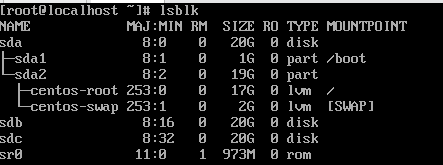
Here, sdb and sdc is the new hard disks that we have added.
Create physical volumes
This is done with pvcreate. This initializes physical volume(s) for later use by the Logical Volume Manager (LVM). Each physical volume can be a disk partition, whole disk, meta-device, or loopback file.
pvcreate /dev/sdb /dev/sdc

pvdisplay command for view volumes
pvdisplay
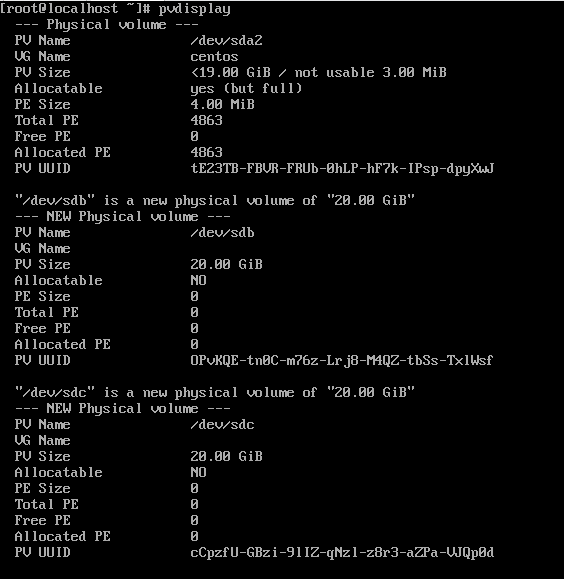
Create a volume group
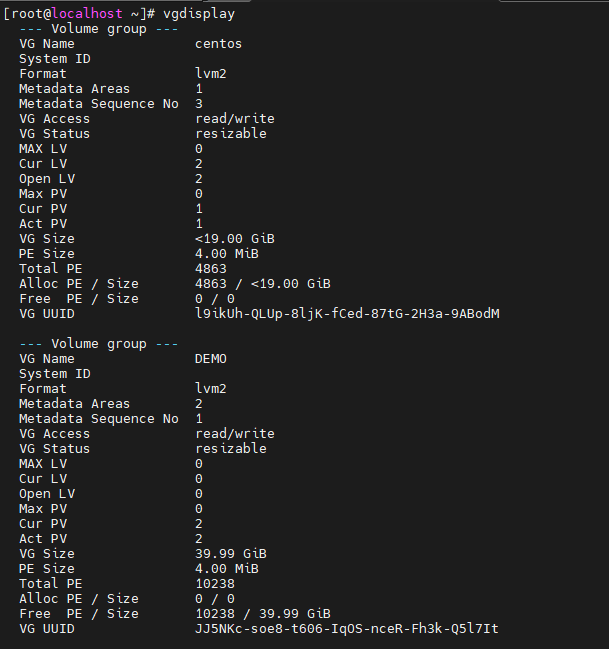
vgcreate creates a new volume group named DEMO on physical volumes /dev/sdb and /dev/sdc.
vgcreate DEMO /dev/sdb /dev/sdc

vgdisplay to view
vgdisplay
Create a logical volume
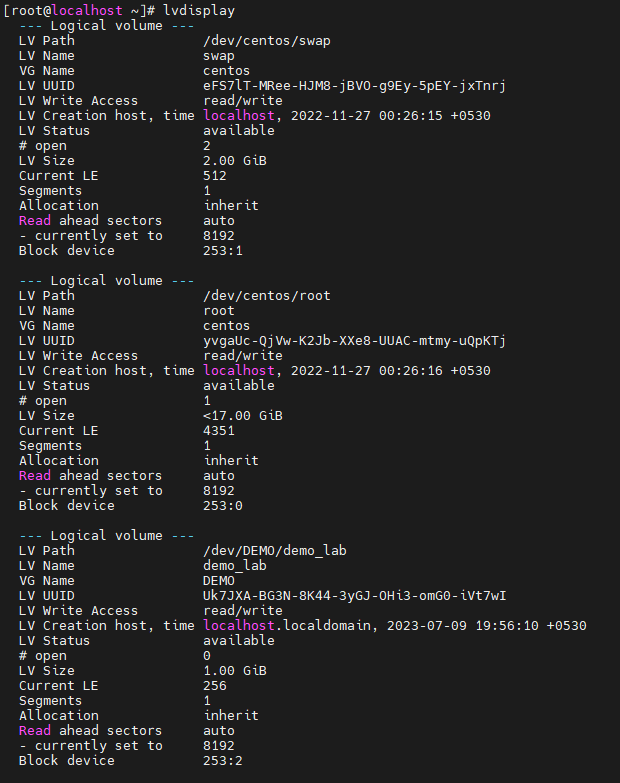
lvcreate creates a logical volume in a volume group. In this case, it's creating a logical volume named demo_lab with a size of 1G in the volume group DEMO.
lvcreate -n demo_lab --size 1G DEMO

lvdisplay to view
lvdisplay
Partition of the new logical volume
fdisk is a dialogue-driven command-line utility that creates and manipulates partition tables and partitions on a hard disk.
fdisk /dev/mapper/DEMO-demo_lab
Here you're asked to press n to create a new partition. then press p for primary then mention size or press enter, enter.
Then again will ask for the option press w to write and exit
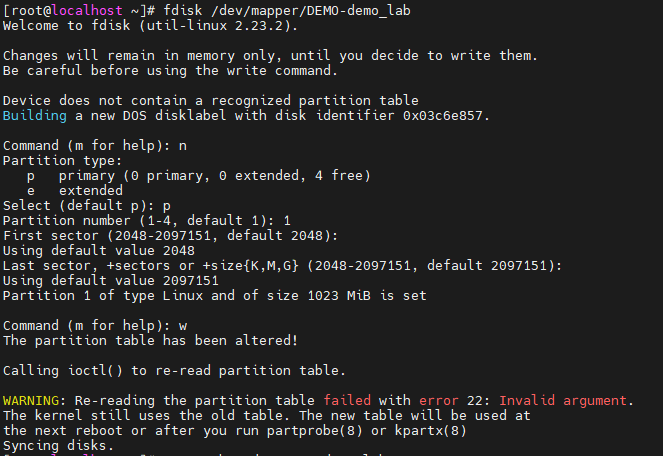
Error:
WARNING: Re-reading the partition table failed with error 22: Invalid argument. The kernel still uses the old table. The new table will be used at the next reboot or after you run partprobe(8) or kpartx(8) Syncing disks.
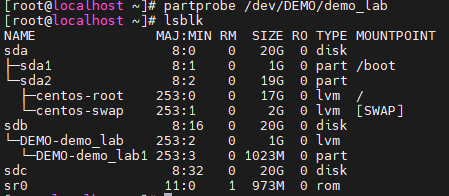
then put the command below
partprobe /dev/DEMO/demo_lab

check if you are able to view the partition with

lsblk
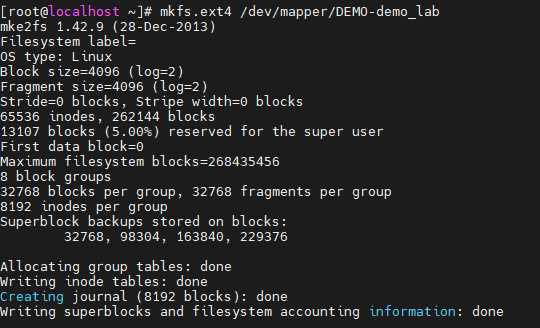
Create a filesystem
mkfs.ext4 is used to create an ext4 filesystem on the partition.
mkfs.ext4 /dev/mapper/DEMO-demo_lab
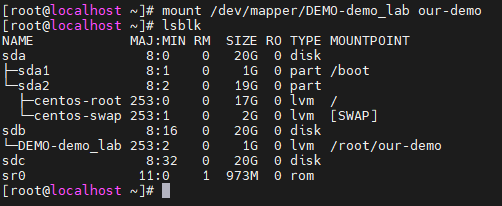
Create a mount point and mount the logical volume
Create a directory that will serve as the mount point, and then use the mount command to mount the logical volume.
mkdir our-demo
mount /dev/mapper/DEMO-demo_lab our-demo
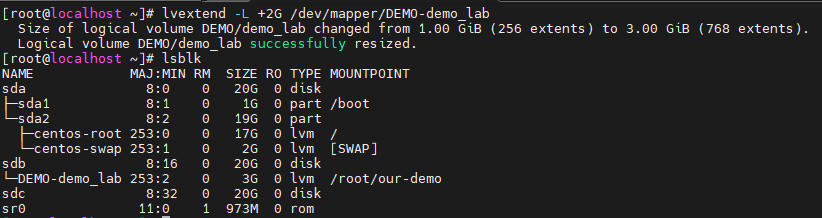
Extend the logical volume
lvextend allows you to extend the size of a logical volume. Here, you're extending the logical volume demo_lab by an additional 2G.
lvextend -L +2G /dev/mapper/DEMO-demo_lab
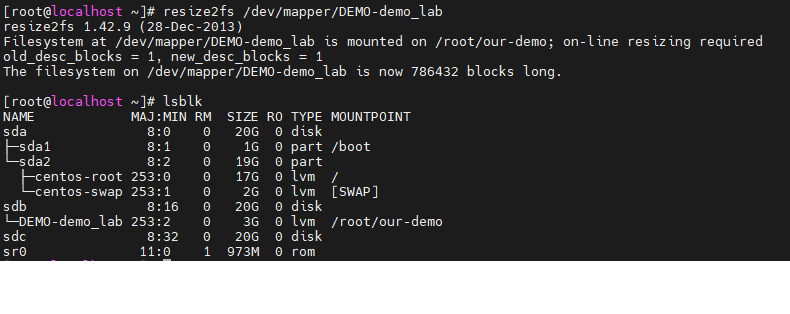
Resize the filesystem
resizefs resize the filesystem on the logical volume to use all of the available space.
resize2fs /dev/mapper/DEMO-demo_lab
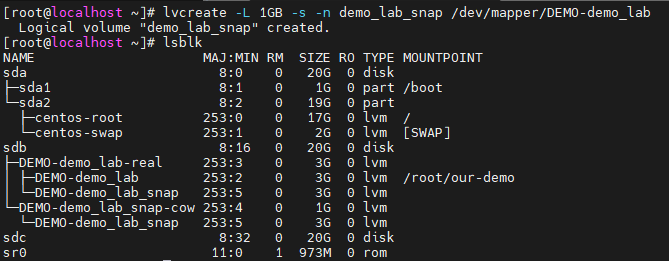
Create a snapshot
lvcreate with -s creates a snapshot logical volume, which is a read-only copy of another logical volume.
lvcreate -L 1GB -s -n demo_lab_snap /dev/mapper/DEMO-demo_lab
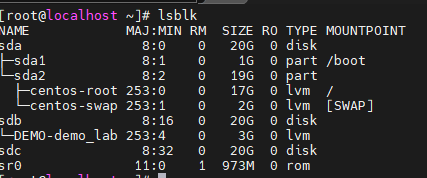
Merge the snapshot
lvconvert with --merge will merge the snapshot back into its origin volume. If both the origin and snapshot volumes are not open the merge will start immediately, otherwise, it will be delayed until the origin volume becomes inactive.
lvconvert --merge /dev/mapper/DEMO-demo_lab_snap

Reboot and you can see the status
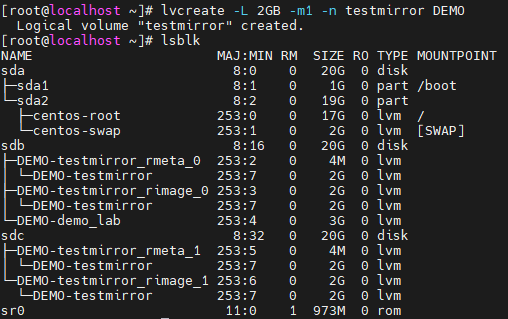
Mirror
It creates a mirror of data in all physical drives
lvcreate -L 2GB -m1 -n testmirror DEMO
Remove a logical volume
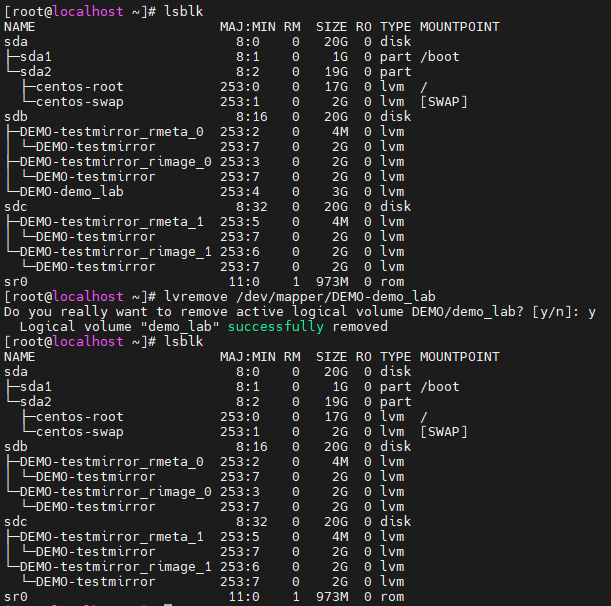
The command lvremove can be used to remove logical volumes. We should make sure a logical volume does not have any valuable data stored on it before we attempt to remove it. Moreover, we should make sure the volume is not mounted.
lvremove /dev/mapper/DEMO-demo_lab
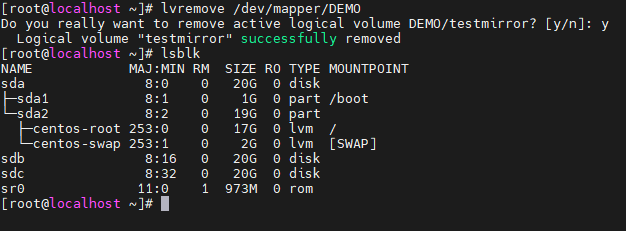
Now to remove the DEMO volume
lvremove /dev/mapper/DEMO
In the above ways we can perform multiple tasks using Logical volume manager.


